
Almost every local service business website has exactly one thing to do: ring us. If the visitor is ready, that works. If they are not, and most are not, they leave and you never know they existed.
That is the gap a lead magnet fills. Not the ebook-and-funnel version sold to online businesses, but something far more ordinary: a useful thing you give a stranger in exchange for the chance to keep talking to them.
The trouble is that nearly all the advice written about lead magnets was written for software companies and online coaches. Applied to a plumber in Reservoir or an accountant in Camberwell, it produces something nobody wants and nobody downloads.

What a lead magnet actually is
Strip away the marketing language and it is a trade. You give something of real value, and the visitor gives you permission to contact them.
Two things follow from that definition, and both get ignored.
The value has to be real to them, not to you. A “free consultation” that is obviously a sales call is not value. Neither is a newsletter nobody asked for.
Permission is the actual product. You are not collecting email addresses. You are buying the right to be useful to someone over the next few months, during which they will eventually need what you sell.
For a local service business, that second point is the whole argument. Someone reading about blocked drains at 11pm may not need a plumber tonight. They will need one within a year, and the business they remember is the one that helped before it sold.
Why the standard advice fails locally
Search for lead magnet ideas and you get ebooks, webinars, email courses, free trials and templates. That advice is not wrong, it is just written for a different business.
Three reasons it does not transfer:
Your customer is not researching a category, they have a problem. Nobody wants a comprehensive guide to electrical safety. They want to know why the power keeps tripping and what it will cost to fix.
The buying window is short and unpredictable. A hot water service fails on a Tuesday. There is no six week nurture sequence in that.
Local trust beats content depth. A one page checklist from a business two suburbs away is more persuasive than a fifty page guide from a stranger.
So the format has to change. Shorter, more specific, more local, and far more practical.
The four tests a local lead magnet has to pass
Before building anything, run the idea through these. If it fails one, it will not work.
- Can it be consumed in two minutes? If it needs an evening, it will not be read, and something unread builds no trust.
- Does it solve a real problem the customer already has? Not a problem you wish they had.
- Is it obviously local? Prices in Australian dollars, suburbs named, local regulations referenced. Generic advice signals a generic business.
- Does it lead naturally to the thing you sell? A checklist about choosing a builder leads to hiring a builder. A guide to indoor plants does not.
That fourth test kills most clever ideas, and it should. A lead magnet that attracts people who will never buy is a cost, not an asset.
The formats that actually work
Here are the ones that earn their place for Australian local service businesses, roughly in order of how well they convert.
| Lead magnet | Best for | Why it works |
|---|---|---|
| Free on-site assessment or quote | Best forTrades, home services, security | Why it worksConverts to an appointment, not just an email |
| Honest price guide for your area | Best forAny service where cost is the first question | Why it worksAnswers what everyone wants and almost nobody publishes |
| Pre-hire checklist | Best forBuilders, renovators, designers | Why it worksPositions you as the safe choice while helping them judge others |
| Compliance or maintenance reminder | Best forBackflow, safety testing, servicing | Why it worksRecurring, genuinely useful, and it books the next job for you |
| Seasonal prep guide | Best forGardens, roofing, pools, heating | Why it worksShort, timely and shareable |
| Fault-finding guide | Best forElectrical, plumbing, appliances | Why it worksCaptures the late-night searcher before they call anyone |
| Simple calculator or estimator | Best forLandscaping, painting, flooring | Why it worksInteractive, memorable, and it qualifies the lead for you |
Two of these deserve more than a row in a table.
The free assessment beats everything else
For most trades and home services, the strongest offer is not a download at all. It is a booked visit.
A free on-site assessment converts a visitor straight into an appointment, skips the email nurture entirely, and puts you in front of the customer where you are most persuasive. It also filters hard: someone who books a time is a real prospect in a way a PDF downloader never is.
The catch is that it costs you an hour and some petrol, so it only makes sense where the job value justifies it. For a $300 callout, no. For a $15,000 renovation, obviously yes.
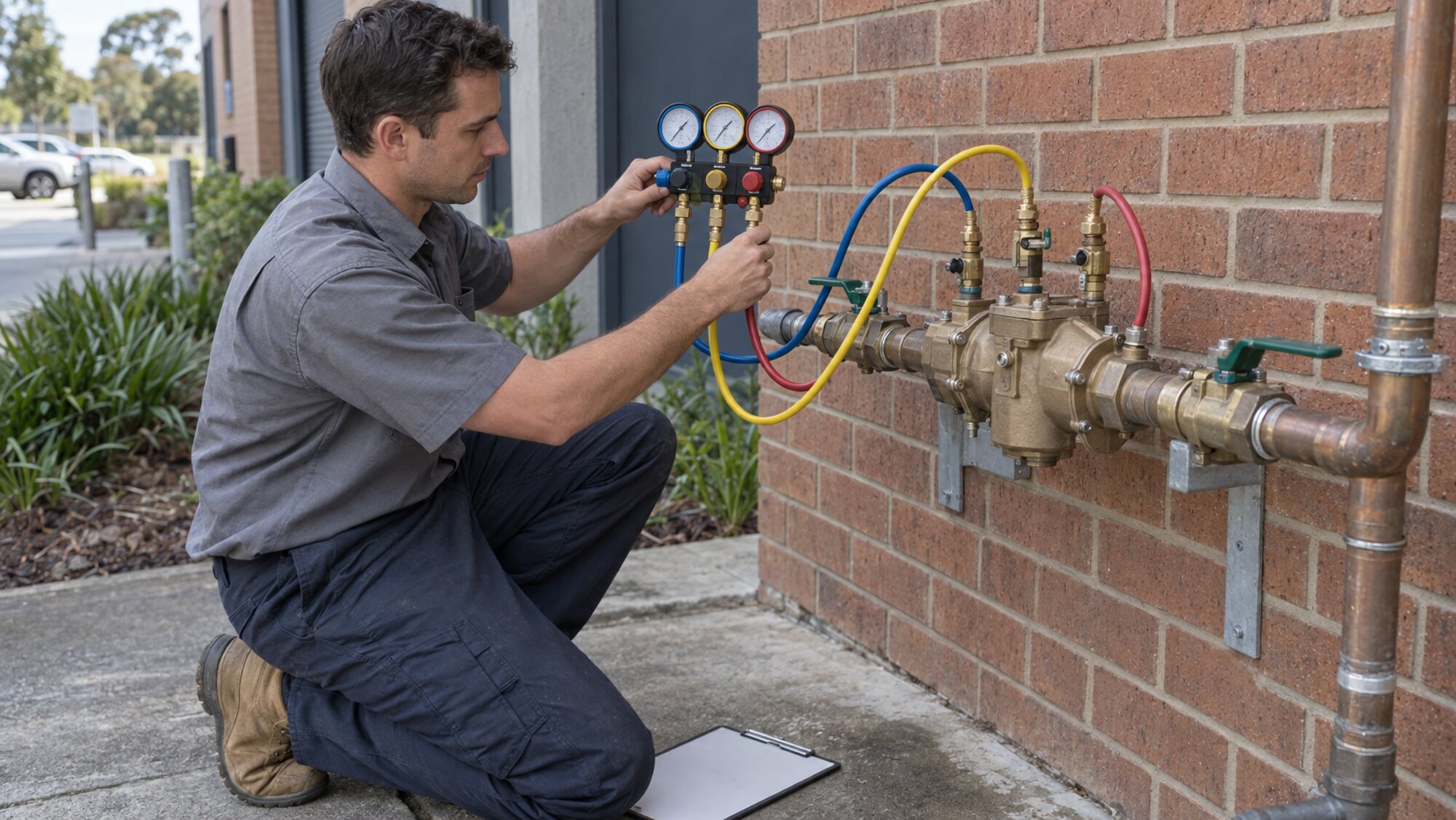
This is also where compliance-driven services have an unfair advantage. When we built the site for Aussie Backflow, the offer almost wrote itself, because backflow testing is a legal obligation on a fixed schedule. A reminder service is not a marketing gimmick there, it is a service the customer actively wants, and it books the following year’s work automatically.
The price guide nobody publishes
Cost is the first question every visitor has. Most businesses refuse to answer it, on the grounds that every job is different.
Every job is different. Publish ranges anyway.
“Most switchboard upgrades in the eastern suburbs run between $1,800 and $3,500, depending on X and Y” does more work than any other sentence on your site. It builds trust immediately, it filters out people who were never going to proceed, and it makes you the business that was straight with them.
If you are nervous about publishing prices openly, a downloadable guide is a reasonable middle ground. You get the contact details, and they get the answer.
What not to bother with
- A newsletter. Nobody wants a newsletter from their plumber. They want to be told when something needs doing.
- A long ebook. It will not be read, and unread material builds nothing.
- A discount as the only offer. It attracts price shoppers and trains customers to wait for a deal.
- A competition or giveaway. You get entries, not prospects. Almost none of them need your service.
- A generic guide with no local detail. If it could have come from any business in the country, it says nothing about you.
- Anything gated behind a long form. Every extra field costs you leads. Name and email, or just a phone number, is enough.
Where to put it
A good offer in the wrong place does nothing. Four positions do most of the work:
- On the relevant service page, not the homepage. Someone reading about bathroom renovations wants the renovation checklist, not a general one.
- At the end of every blog post, matched to the topic of that post.
- In the sidebar or a footer band, present but not shouting.
- As an exit-intent or scroll-triggered prompt, used sparingly. One, on desktop, after real engagement. Never an immediate pop-up on mobile, which Google’s page experience guidance treats as an intrusive interstitial and which annoys everyone.
The pattern to avoid is the single site-wide offer sitting on every page regardless of context. Relevance is most of the conversion rate. If your pages are not already earning attention, the offer will not save them, which is why service pages that rank and convert come first and lead magnets come second.
The legal part, which most advice skips
Collecting an email address in Australia comes with obligations, and they are not onerous, but ignoring them is a genuine risk.
The Spam Act. Commercial electronic messages need consent, must clearly identify your business, and must include a functional unsubscribe. The ACMA enforces this, and penalties are real. Someone downloading a checklist gives you reasonable grounds to send related material. It is not consent to email them about anything, forever.
Privacy. Once you hold personal information you have obligations about how it is stored and used, set out by the OAIC. For a small business the practical version is short: say what you will do with the details, do only that, keep them secure, and delete them when asked.
In plain terms, three habits keep you clear:
- Say on the form exactly what they are signing up for.
- Put a working unsubscribe in every email.
- Do not buy lists, and do not add people who never opted in.
What happens after the download
This is where most lead magnets quietly fail. The file sends, and then nothing.
A follow-up sequence for a local service business should be short and unembarrassing. Four emails is plenty:
- Immediately: the thing they asked for, plus one sentence on who you are.
- Two days later: the single most useful thing you know about this problem.
- A week later: a real local job you did, with a photo and what it cost.
- Two weeks later: a plain offer to help, and permission to hear nothing more.
Then stop, or drop to something genuinely occasional. A quarterly seasonal reminder from a roofer is welcome. A weekly email from anyone is not.
Write them as you would speak. The fourth email doing its job is worth more than twelve clever ones nobody opens.

Measuring whether it works
Judge the offer on booked work, not downloads. Three numbers are enough:
- Conversion rate of the page it sits on. Two to five per cent is a reasonable target for a download offer on a service page.
- Cost per lead. Especially if you are running ads to it.
- How many became customers, and how long it took. This is the only number that settles the argument.
A hundred downloads that book nothing is a worse outcome than eight assessments that book three jobs. When we set up the local marketing for U-Nome Security, the useful measure was never form fills, it was how many site assessments turned into installed systems.
If you are not tracking that far, you cannot tell a good offer from a popular one, which is the same problem covered in the marketing metrics that actually matter.
Frequently Asked Questions
What is a lead magnet for a service business?
It is something genuinely useful you give a visitor in exchange for their contact details, so you can keep talking to people who are not ready to book yet. For a local service business it is rarely an ebook. It is more often a price guide, a pre-purchase checklist, or a free on-site assessment. The point is to capture the eighty or ninety per cent of visitors who leave without ringing.
Do lead magnets work for tradies?
Yes, but not the kind marketed to online businesses. Nobody wants a forty page PDF from their plumber. What works is short, specific and local. A one page checklist of what to look for before hiring, a straight answer on what a job costs in your area, or a booked inspection. If it cannot be consumed in two minutes or booked in two taps, it will not convert.
What is the best lead magnet for a local business?
For most trades and home services it is a free on-site assessment or quote, because it converts the visitor straight into a real appointment rather than an email address. The best runner-up is an honest price guide, since cost is the question every visitor has and almost nobody answers it. Pick the one that matches how your customers actually decide.
Can I email people who downloaded my free guide?
Only within limits. Australia’s Spam Act requires consent, clear identification of your business, and a working unsubscribe in every commercial message. Downloading a guide gives you reasonable grounds to send related material, not a licence to email indefinitely about anything. Say plainly what you will send, keep it relevant, and make unsubscribing easy.
How many leads should a lead magnet generate?
Judge it on booked jobs, not downloads. A well-placed offer on a service page might convert two to five per cent of visitors, and a free assessment offer often converts lower but produces far better leads. A hundred downloads that book nothing is worse than eight assessments that book three jobs. Track the offer through to work won.
The bottom line
Most local service websites ask for the one thing most visitors are not ready to give. A lead magnet gives those people somewhere to go instead of away.
It does not need to be clever. Answer the price question honestly. Offer the inspection. Write the one page checklist that helps someone judge your trade, including your competitors. Then follow up like a person, four times, and stop.
The businesses that win here are not running sophisticated funnels. They are being useful earlier than everyone else, and being remembered for it when the hot water finally goes.
If your website isn’t converting visitors into customers, let’s discuss how a professionally designed website with the right offer in the right place can help. Request a chat or get in touch, and have a look at the local businesses we’ve built this for.