
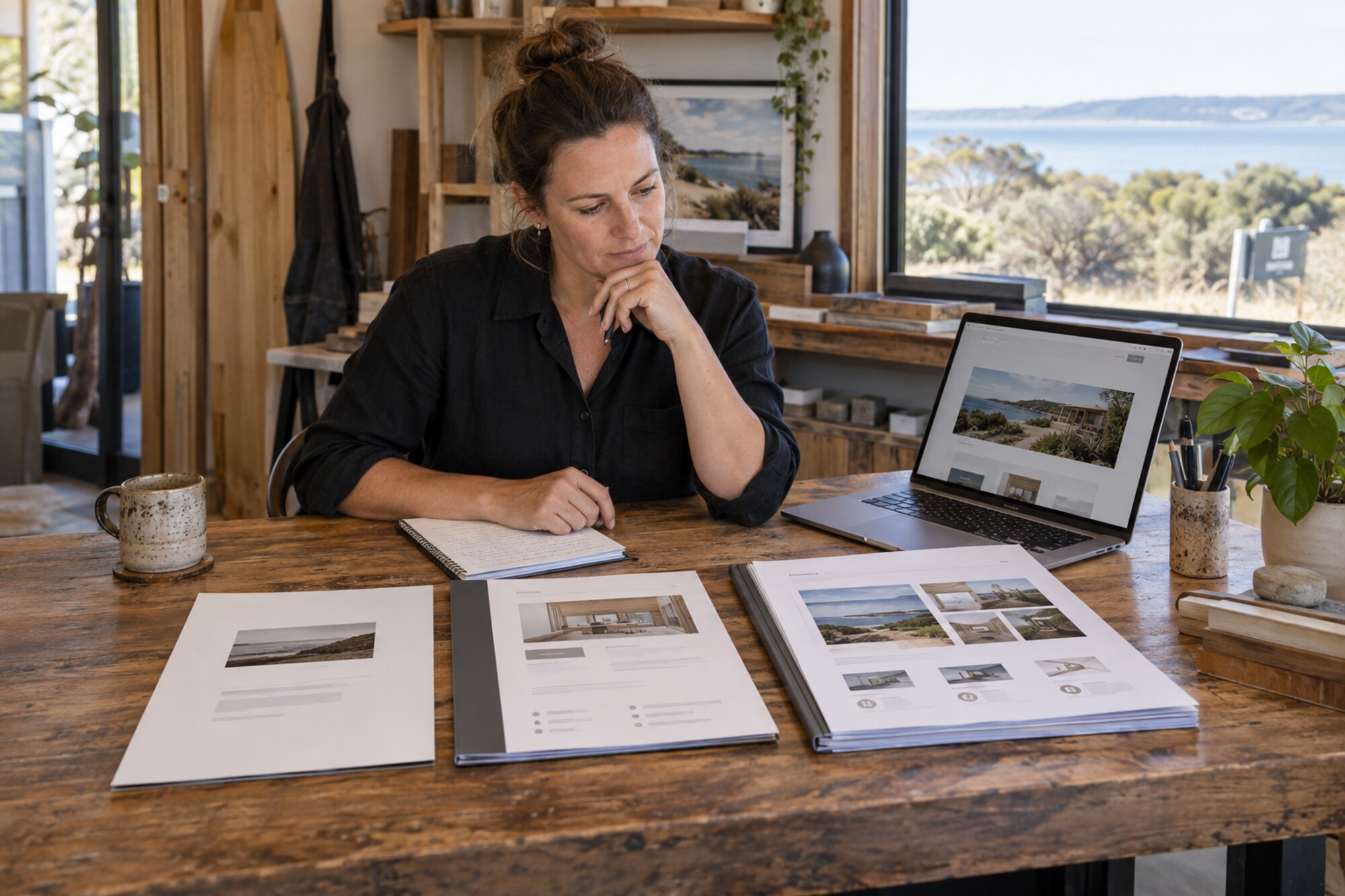
Ask three people what a website should cost on the Mornington Peninsula and you will get three answers thousands of dollars apart. One quote comes in at a few hundred. One lands in the low thousands. One arrives with a proposal document and a number that makes you put the kettle on.
None of them is necessarily wrong. They are just quoting for different things, and unless you know what those things are, the only tool you have for comparing them is price. That is how businesses end up with a website that was cheap to buy and expensive to own.
This is not a price list. If you want the national picture, our guide to what a small business website costs in Australia sets out the typical bands and what drives them up or down. This is about the decision you are actually making down here: what your money buys on the Peninsula, what it should be spent on first, and when to spend it.
Why the same job gets quoted three different ways
The quotes vary because the scope varies, almost always in ways the quote itself does not spell out.
A very cheap quote usually means a template, filled in with your details, with the copy left to you. That is a real product and it has a real place. It is not the same product as a site designed around what your business actually does.
A middle quote usually includes design, build and some search setup, with content either written for you or written by you. This is where most small business sites land, and where most of the value is.
A high quote usually includes the things that are easy to leave out of a proposal and hard to add later: copywriting, photography, a plan for who does what after launch, and someone accountable when something breaks.
The fastest way to compare three quotes is to stop reading the totals and ask each one the same four questions:
- Who writes the words? If the answer is you, that is not a saving, it is a task. Most projects that stall, stall here.
- Where do the images come from? Stock, your existing photos, or a shoot. This matters more on the Peninsula than almost anywhere, for reasons below.
- What happens after launch? Who updates it, who hosts it, who fixes it at 6pm on a Friday, and what does that cost.
- Who owns it? Your domain, your hosting, your content. If leaving means starting again, that is a cost, just not one on the quote.
Four honest answers will usually explain a spread of several thousand dollars without anyone being dishonest about it.
The two people your website has to convince down here
This is the part that genuinely differs on the Peninsula, and it is the part that decides how much site you need.
The first person is local. They already know where Mount Martha is, they have probably driven past you, and they are checking three things: are you still trading, do you look like you do good work, and how fast can they get hold of you. That visit lasts under a minute, on a phone, often in a car.
The second person is looking down here from somewhere else. A Melbourne buyer renovating in Sorrento. A family who has just bought in Blairgowrie and needs half a dozen trades. Someone comparing three Peninsula businesses in browser tabs because they cannot drop in and have a look.
That second person has no local knowledge to fall back on. Everything they decide, they decide off your website. They want evidence: real photographs of real work, a sense of price, and enough detail to believe you have done this before.
Those two people cost different amounts to serve. If your work comes almost entirely from locals and word of mouth, you need a fast, clear, honest site and not much more. If a meaningful share of your work comes from people who have never met you, you are buying proof, and proof costs more to produce than pages do.
Most Peninsula businesses we speak to are somewhere between the two, and most of them have never actually worked out which. It is worth twenty minutes with a coffee before you spend a cent, because it changes the brief completely.
Photography is the line item worth protecting
If there is one place not to economise on a Peninsula website, it is the pictures.
The Peninsula sells on how it looks. That is true of the wineries and the accommodation, and it is just as true of a builder, a landscaper or an interior designer whose work is judged on appearance. A site full of generic stock people in a generic office undoes that in about two seconds, and the visitor cannot always tell you why they did not trust it.
Gillian Cole Design in Mornington is the clearest example we have. An interior designer with commissions running from private residences on the Peninsula to heritage and exhibition work in London and Basel is judged on taste before a word is read. The site we built is deliberately restrained and photography-led, because the work has to carry it. Nothing else would have been credible.
You do not necessarily need a full shoot. In rough order of value for money:
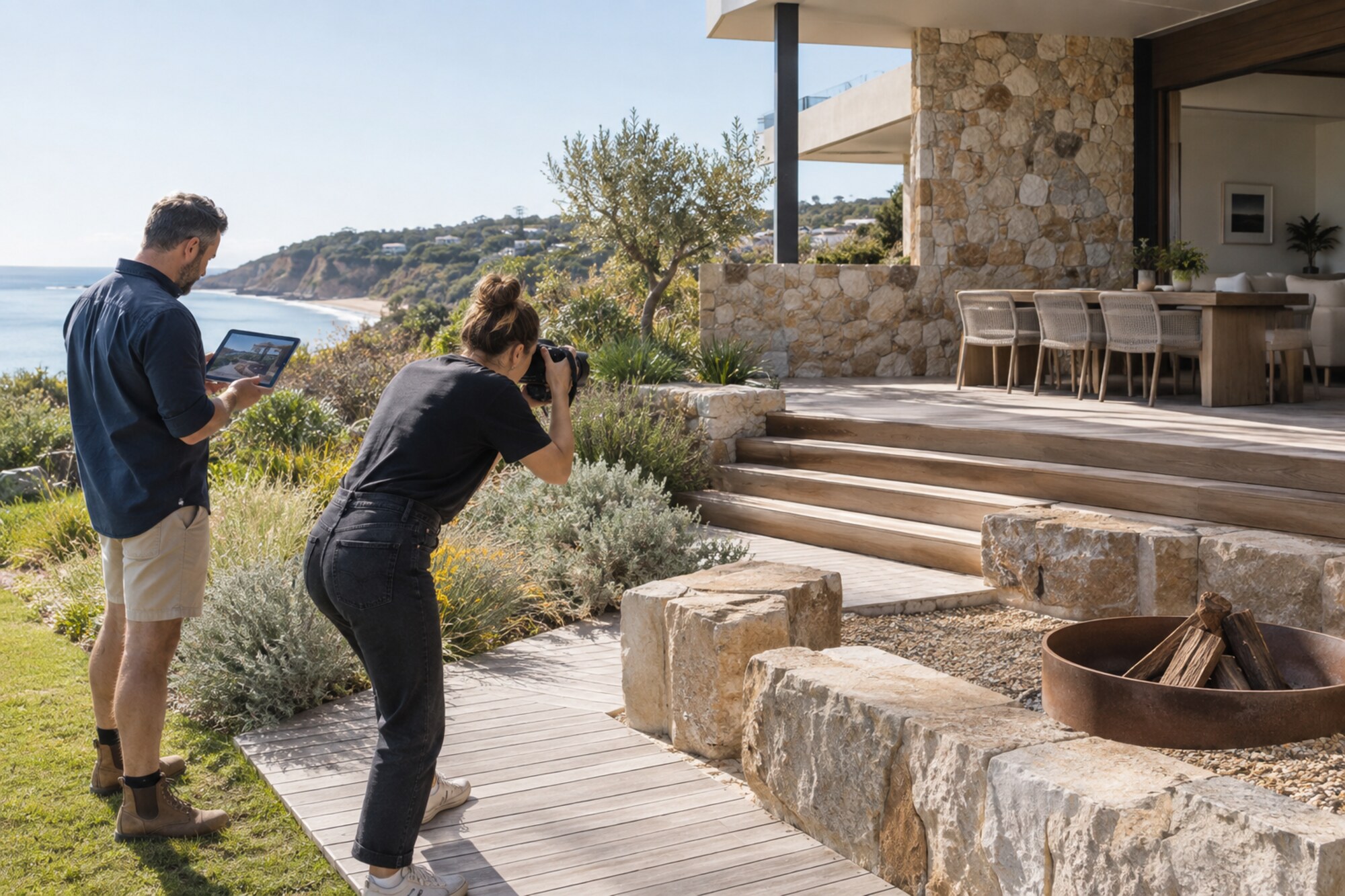
- A half day with a photographer on a real job. The best option for most trades and home services. One session covers a year of content.
- Your own phone photos, taken properly. Good light, no clutter, plenty of them. Genuinely better than stock, and free.
- Stock, used sparingly, for backgrounds only. Never for the work itself and never for people who are supposed to be your team.
The mistake is treating photography as a nice-to-have and discovering after launch that the site has nothing real in it.
Timing, and why winter is the cheapest month to buy
A lot of Peninsula trade arrives with the summer population. Accommodation, hospitality, trades, home services and anything that serves second-home owners all feel it.
Search does not work on that timetable. Search engine optimisation compounds over months, so a site launched in June is doing its job by December. A site launched in December is not helping that summer at all, no matter how good it is. If you are reading this in winter, that timing is in your favour.
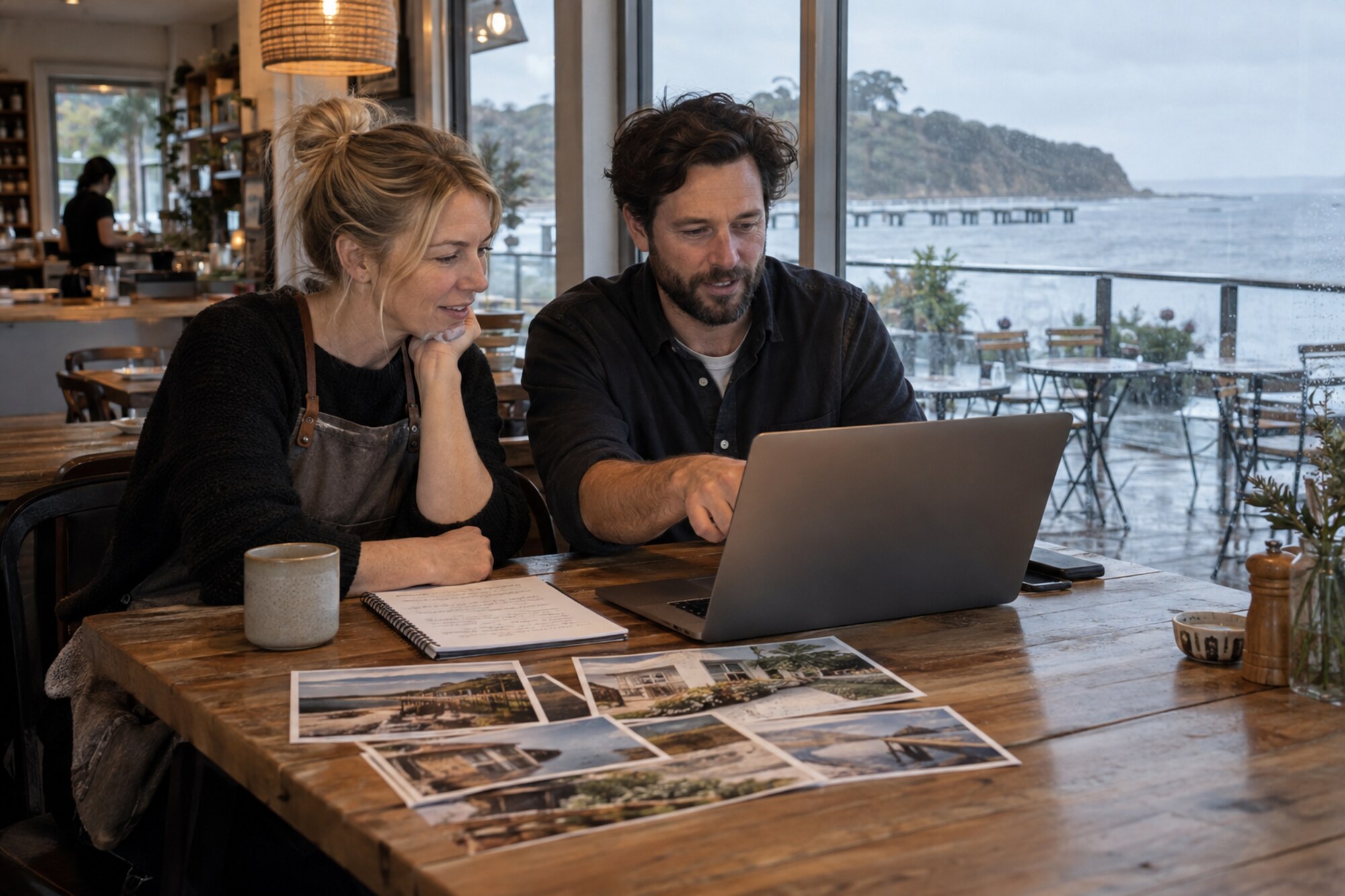
There is a second, less obvious saving. Website projects are slowed down more by the client than the agency, almost every time, and the delay is nearly always the same two things: photographs and answers to questions. In your quiet months you have time to do both properly. In December you do not, and a project that drags across a busy season costs more in your own hours than any line on the quote.
If your season has already started and you need enquiries now, that is a different tool. Paid advertising can be turned on and off in a way search cannot, and the honest answer for that year is usually to run ads while the site and its search work are built for next year.
How far you work decides how much site you need
Google weights how close a searcher is standing to you very heavily in local results. On the Peninsula that is not a detail, it is the whole game. It is about an hour from Frankston to Portsea, so a plumber in Rosebud and a plumber in Mount Eliza are barely competing with each other even though both would tell you they cover the Peninsula.
The practical consequence is that the size of your website should follow the size of your actual service area.
If you genuinely work three suburbs, you need three good pages about those places, not fifteen thin ones with the name swapped. Near-identical location pages are the doorway page pattern that Google’s own guidance has warned against for years, and they cost money to build while actively working against you.
If you cover the whole Peninsula, you need more, and it will cost more, because each page has to say something genuinely different to earn its place.
And if you are based here but sell elsewhere, local pages are close to worthless. Worm Farm Waste Systems is based in Dromana and supplies organic waste and septic systems across Australia. Their site is built to be found nationally, not to win Dromana searches, because being based somewhere and selling to that place are two very different things. Money spent on local optimisation there would have been money wasted.
What you can safely leave out
Plenty of things sold as essential are not, at least not yet.
- A blog you will not write. An empty blog dated eighteen months ago is worse than no blog. Skip it until you have a plan for who writes it.
- A custom booking system, if a phone number and a form are doing the job. Add it when the volume justifies it.
- A members area or login, unless you can name the people who will log in.
- Animation and effects. They add build time and load time, and they are the first thing to break on a patchy connection between Mount Eliza and Rosebud.
- Ten stock photos of people who do not work for you.
What is genuinely not optional is a fast, mobile-first build, a real phone number that is never more than a thumb away, honest pages about what you do and where, and a Google Business Profile set up properly. That last one is free, takes an afternoon, and outperforms most of the things people pay extra for.
Funkesound in Frankston is a good illustration of the priorities. They fit TV antennas, wall mounting and home theatre across Melbourne and the Peninsula, and what they needed was to be found locally and called quickly, not a showpiece. The website, local search work and branding were built around that, and the ad spend stayed low because the free and cheap things were done properly first.
So what should you budget?
The honest answer is that it depends on which of those two people you are trying to convince, and how far you work.
A local trade working a handful of suburbs, with decent photos of its own work, can get a genuinely good site for a modest number. A business selling to people who have never been down here, whose work is judged on appearance, is buying proof as well as pages, and should expect to spend more, mostly on content and photography rather than on the build.
What matters more than the number is knowing what is inside it. The Australian Government’s guidance on getting your business online is a sensible starting point if you want a neutral second opinion before you commit.
Whatever you spend, spend it on the parts a customer actually sees and uses. Nobody has ever chosen a Peninsula business because its website had a nice page transition.
Frequently Asked Questions
How much does a website cost on the Mornington Peninsula? The same as anywhere else in Victoria, because the work is the same work. A straightforward site for a small local business generally lands in the low thousands, and larger builds with e-commerce or bookings go up from there. What changes down here is not the rate but what you need, which depends heavily on whether your customers are three suburbs away or in Melbourne.
Why do quotes for the same website vary so much? Because the quotes are usually not for the same website. One may include copywriting, photography and search setup while another covers the build alone, and a template filled in over a weekend is genuinely cheaper than a site designed for your business. Ask each quote what happens after launch and the differences usually explain themselves.
Is a cheap template website ever the right call? Sometimes, yes. If you are testing whether a business idea has legs, or your work comes entirely from word of mouth and you just need somewhere to point people, a modest site is a sensible decision rather than a compromise. It becomes a false economy once you are spending real money trying to be found.
When is the best time of year to commission a website? Winter, if your trade is seasonal. Search takes months to compound, so a site launched in June is working by December, and one launched in December is not helping that summer at all. Quiet months are also when you have the time to answer questions properly, which makes the project faster and cheaper.
Do I need professional photography for a Peninsula website? It is the line item worth protecting more than most. The Peninsula sells on how it looks, and a site full of generic stock imagery undoes that immediately. It does not have to be a full shoot. A half day on site, or even good phone photos of real work, beats stock every time.
The bottom line
A website cost on the Mornington Peninsula is not really a single number. It is a set of decisions about who you are trying to convince, how far you work, and what you can honestly show them.
Get those three right and a modest budget goes a long way. Get them wrong and a large one buys you a good-looking site that nobody local can find and nobody from Melbourne believes.
If you are weighing up quotes and want a straight opinion on what you actually need, get in touch. We will tell you if a new site is the wrong first step, which it sometimes is. You can also see how we approach Peninsula websites or browse the work we have done.